
You are training when feeding
You may not have ever thought of it this way, but every time you feed your horses, you are either training them or reinforcing that training.
It’s also a great way to train new behaviours and leaves your horse respectful around feed and keen to offer you something to get their feed.
Or, you can solve bad behavoiour problems around feeding simply by being aware of when and how you deliver the feed.
Animal trainers using positive reinforcement generally use food as the reward – think dolphins, whales, seals, birds of prey and other ‘wild’ unharnessed animals that are trained to perform for the public. They are all rewarded with food for their performances which have been carefully built in a progressive and positive way.
The same type of training used with horses and dogs is referred to as ‘Clicker Training’ – small food treats follow an auditory signal (the click or similar) every time the animal does what is asked. Then when it performs really well it is often given a much bigger or more yummy food treat called a ‘jackpot’.
The bucket feed we give our horses each day is like a big jackpot but unless we ask for a particular behaviour, the reward is for whatever they do just prior to getting the food.
If that is pulling a nasty face, pushing into our space, or turning around and kicking out then we are basically rewarding bad behaviour by putting the feed out as quickly as we can.
If something is not done to nip it in the bud, then the behaviour will get worse.
If your horse is polite around feed, but you’d like to teach them a new behaviour like backing away, or lowering their head, or lifting a leg – then asking for this before giving the feed will enhance their learning.
You just need to be aware of being clear in the way you’re asking, being patient enough to wait for the behaviour you want and delivering the food at the right time.
If you’re feeding horses in a group, its best to practice with each horse in an individual area first, or pecking order scuffles might be a problem and those waiting will get frustrated and perhaps miss out when the first horse finishes.
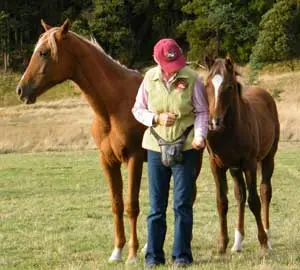
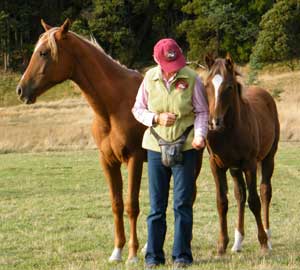
Photo: I teach all my youngsters to turn their head away to wait for a treat or their feed to be delivered. Fiera on the left is doing this nicely and waiting, while little Aria is being rewarded for a step in the right direction.
When dealing with bad behaviour its probably safer to stay on the other side of the fence at first and wait for a ‘pretty face’ or standing quietly away from you before you give them the bucket.
If you want to develop the good behaviour faster while in this individual space, then deliver the food one handful at a time into another feed tub, then wait for the good behaviour to occur again.
If you haven’t got the patience to wait for the horse to offer the behaviour (free shaping), then you can do something to instigate it such as waving a flag on a stick to indicate mving away, or put your ears up etc. This will mean you need to carry the flag with you whenever you feed, but that’s a good idea if you’re dealing with an agressive horse anyway.
When the behaviour becomes established you can change the cue (flag) to something more subtle such as your fingers clicking. by adding the new cue in just prior to the old one.
For well behaved horses learning something new the process is the same, although you will probably need to have some sort of cue to tell them what you want.
For backing you might wave your finger flap your arm up and down. Once the horse understands, you can add in a voice cue as well and gradually drop the visual cue.
If your horse gets ‘grabby’ and rushes in to take the food when it is delivered, just remove the food and wait for patient behaviour again. The same goes for feeding by hand – if your horse is too enthusiastic in the way they take the food, close and even remove your hand, and offer it again when the horse shows gentle behaviour.
Feeding your horse can be a fun and rewarding experience for both of you if you take the time to establish some boundaries and be patient enough to stick with them consistently.

All articles are authored by Cynthia Cooper (unless otherwise stated) and may be reprinted with permission, aknowledgement and a link to my web site please.