
Weaning problems in horses
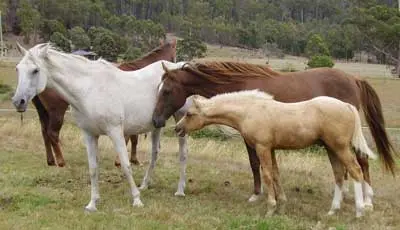
Traditional Weaning practices can result in behavioral and social problems.

Hearing of horses with social issues – usually, aggression towards other horses has widened my search for proof that these problems can be caused by traditional weaning practices.
For years now, I have seen the difference in my own horses by weaning them close to their natural weaning time of 10-12 months and giving them a social up-bringing with herd members of various ages. Their progressive weaning was relatively stress-free, and after the physical weaning from nursing was achieved (it takes 4-6 weeks for the mares milk to dry up), they lived with their mum (and father when I was still breeding) as they would in the wild.
This quote from Marthe Kiley-Worthington, author of ‘Horse Watch: What it is to be Equine’ shows us what she has observed in her years of studying equine ethology;
“Foals are usually weaned between four and six months old. This causes profound trauma and distress to both the foal and the mother. Since the attachment between mother and foal has been selected for and is molded by the lifetime experiences of the animals, it seems foolhardy to break this bond in a sudden way when the foal is so young.
In fact, our recent work indicates that it is at this time that the foal may begin to exhibit stereotypes, that is ‘vices’ such as crib-biting, weaving, head throwing, etc.”.

According to Kiley-Worthington ” The between (inter) generation bond is very strong and is also crucial for the normal behavioral development of the foal. In the absence of their mother, when given a choice, the foal, up to and over a year will attach itself to other adult mares rather than others of the same age, even if he is familiar with his peers.
It is from older animals that they acquire knowledge: social learning. ”
“Consequently in order to have a young equine who is behaviourally normal, it is important to ensure youngsters are not weaned before 9 months.”
As I’ve discovered, it is better to let the mare wean the foal herself which she will do if back in foal, between 10 and 11 months – usually a few weeks prior to foaling again. If the mare is not back in foal, she will not have hormone changes driving her to wean the foal. Then I’ve found a progressive separation over an electric tape fence enabling mare and foal to touch but not nurse, is the least stressful. This works very well with a track system so that the mare is on the perimeter of the paddock with the foal in the middle with the rest of the herd or at least one older gentle companion.
It is important in whatever situation you use, that the foal can always see the mare and has the larger space to choose to move further afield when they are ready.

Socially it is far better for weaned foals to have other mares and foals to live with rather than isolating the youngsters in a group as many studs do. They can then learn appropriate behavior from other adults to develop good social skills.
So often it’s the owners of ex-racehorses that I hear from with herd aggression issues. Generally, foals destined for the racetrack are weaned far too early because the racing economy is dictated by money and it costs more to feed mares with older foals properly.
They are then put into peer groups prior to isolation (stabled) from the time they are prepared for yearling sales or ‘broken in’ as pre-two-year-olds. What hope do they have to learn any social skills?
These horses then become quite defensive of their own space or form strong emotional attachments to particular horses that cause them to be overly aggressive to others in the herd when they finally get to live like a natural horse.
Another issue that stems from weaning too early or suddenly is separation anxiety. Horses that were weaned by taking the mare away suddenly seem much more insecure when leaving their herd or when the horse they are most bonded with leaves.
I’ve seen the results in my own horses, some of which were weaned stressfully (the older horses before I knew better) and others more recently who have never been weaned from their family herd.
They are the most confident and keen to leave or go out of sight of their mother without any anxiety and they also have excellent social skills when meeting new horses, being both polite and able to read the other horse’s signals.
This article also highlights some recent research on weaning that concluded: “We now have a better scientific base of knowledge about weaning in horses, like an understanding (from previous studies) of some of the effects of artificial weaning such as high levels of stress and the introduction of coping mechanisms like stereotypies, and, in this new study, of the way natural weaning occurs,”
So if we are to raise confident and socially well-adjusted horses, then weaning at 9-12 months along with choosing a gradual weaning method and appropriate herd members is a very important part of their development. To read more about Progressive Weaning Naturally click here.