
New Ways for Weaning Foals
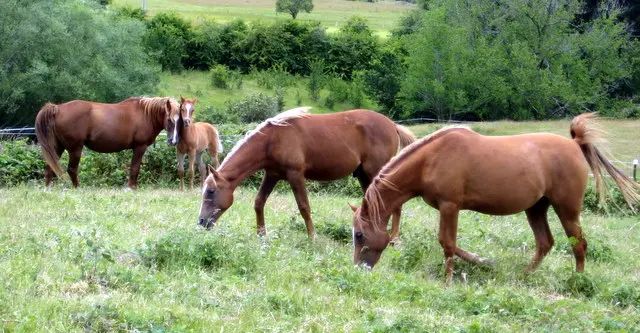
The time for weaning foals is approaching and thus begins what can be a very stressful event for both the mare her foal.

But it needn’t be if we consider how horses naturally wean their foals. Family structure is an incredibly important part of a horse’s life – young horses need role models and teachers they can trust. Sadly this isn’t often thought about in our world that is so often driven by economics, greed and the need for fast results.
An Equus magazine article on weaning has prompted me to write this post. The article referred to recent research that outlined the behavioural and physiological responses to different weaning protocols (by Christine Aurich et al) and gave some examples of the different ways to wean.
Weaning Methods
These included the traditional ‘remove mare suddenly out of earshot/sight’ method which is considered the most stressful, to weaning in pairs or in a group (still with the sudden removal of the mare), with a ‘baby sitter’ or by removing one mare at a time from a group.
Gradual separation was also covered but considered to be more time consuming and unsafe if the foal was on the other side of a fence to its mother. It was also said to be more stressful for both, probably because the foal’s milk supply is stopped suddenly and the mare is still ultimately taken away completely, plus the length of separation may be in too large a chunk to be as gradual as the foal really needs.
Some of these methods also rely on having more than 1 or 2 mares and foals which makes them impractical for the small breeder.
The one method the article didn’t present that produces no stress at all for mare or foal, is the ‘progressive weaning’ method. While this method hasn’t been scientifically studied (and perhaps the reason it wasn’t included) myself and others have experienced great results, and feel it could be more widely shared and hope one day it will become the most accepted way of weaning.
Progressive weaning very gradually increases (by the hours) the time of separation, and decreases the ability to drink, over a period of around two weeks, always ensuring that the mare and foal can see each other and touch noses. This method allows the mare’s milk to dry up slowly (reducing the risk of mastitis), as the mare is never completely taken away, and eventually when the milk has completely dried up 6-8 weeks) the pair can be reunited to benefit from the social bonds and learning they experience in the wild.

This method is best done using a ‘paddock’ track system so that the foal is on the inside of the track where it can access more feed and is with friends, and the mare is on the perimeter track, on restricted grass to help the milk reduce, and the pair can move anywhere in the pasture but remain within sight and contact. An electric fence is also safer to use for this purpose and only needs to consist of 2 strands of high visibility tape or poly wire. If a track system is not used, then any safe pasture can be divided by an electric fence to give the foal constant sight of the mare, but the ability to move further away as it becomes more confident.
Weaning Age
Also in the article, the age of weaning was quoted as the “generally accepted age of between 4 and 6 months” which is much earlier than this would occur in a natural situation where the mare will self wean the foal at between 10-11 months or just prior to giving birth again.
In her book ‘Horse Watch: What it is to be Equine’ – Marthe Kiley-Worthington says “the between-(inter) generation bond is very strong and is also crucial for the normal development of the foal. ..The effect of artificial weaning (usually incorrectly advocated for between 3 and 6 months) frequently results in trauma to the foal who, thereafter, may show evidence of behavioural distress. It is often forced weaning of this type that stereotypes such as crib-biting, wind-sucking, weaving or head throwing show a significant increase in performance. ….. in order to have a young equine who is behaviourally normal, that wants to learn, and does not have any pathological behaviour, it is important to ensure that the youngsters are not weaned before 9 months. If possible leave the mother to wean the foal herself as she would in the wild before she foals again.”
In my experience as a breeder for over 40 years, I have also noticed the horses that are progressively weaned are much more independent and suffer much less ‘separation anxiety’ than those that are weaned suddenly.
Many times I hear the excuse that the foal must be weaned because the mare is losing condition, is back in foal (and presumably needs all her nutrition to grow the next foal) or the mare won’t wean the foal herself because she’s not back in foal.
My answer to this is; if you can’t feed your mare sufficiently well enough to maintain reasonable body weight (its to be expected that she will drop some weight) then you should learn more about nutrition and what to feed, or simply feed more!
A mare that’s back in foal is designed by nature to be in foal and feed one, so provided she has good nutrition there’s no reason she can’t support two at a time.

If the mare isn’t back in foal then it’s true – she may not wean the foal herself, but the time and method of weaning can then be done when its least traumatic for the foal which is around 10-12 months old. If there’s no harm being done, why not leave them together and see if nature will take its course. Many mares will get sick of the foal drinking at around 12 months and may just wean themselves.
If the owner wants to use the mare again and can’t wait, then the foal can be gradually taught to have her leave for short periods (initially within sight) or it can be taken along for the ride. Foals of 4-6 months of age or older are quite capable of keeping up on a trail ride and the experience will be an invaluable education for them.
Stress-Free Weaning
So if you want to have a well-adjusted foal that is confident and free of social or physiological issues, read more about progressive weaning here and follow these ingredients for stress-free weaning which are:
- Raising in a herd with horses of varied ages and if possible a young friend to play with.
- Wean at no earlier than 9 months of age, preferably closer to 12 months.
- Wean progressively and with friends in a familiar environment.
- Wean when the foal is physically well, not under any other stress such as from worming, gelding, other vet treatment etc.
- Practice short periods of separation when the foal is offering that behaviour itself (ie straying far from the mare and even going out of her sight without worrying).
Here is an example of how progressive weaning worked for one foal owner:

“My husband and I are the proud owners of a 10-month-old filly. Its the first time we’ve bred a horse or had a foal, although we’ve been into horses for years and years. I just wanted to let you know we were searching for help about weaning a few months ago and came across an article on your website. We are avid Parelli fans and use it daily with all our horses. So of course, we wanted to wean as naturally as possible with the least amount of angst for either Mom or baby.
The article was awesome and we followed it pretty well. I just wanted to tell you how thankful we were and to let you know the whole process was uneventful, stress-free, and totally successful! All we did was put Sweet P (our mare) into a big paddock and left Nito (our filly) out with our two boys. At the time Nito was about 9 months old. She had already bonded to our big Dutch warmblood so it worked perfectly. She could nose her mom over the fence but not nurse. After six weeks we just let mom back out and bingo, Nito tried to sniff near her mom’s teats but Sweet P put her ears back, lifted her back leg, and/or bit her on the bum. Happened a couple of times and that was it! Sweet! Then Nito just went over and stood on the pedestal for fun!
Dont’cha just LOVE horses!?!
Anyway, thanks so much for sharing your information. I’ve signed up for your newsletter as well and want to peruse your website some more as I find time!” Cheryl Hogg, Certified BodyTalk Practitioner, USA.
This article also highlights some recent research on weaning that concluded: “We now have a better scientific base of knowledge about weaning in horses, like an understanding (from previous studies) of some of the effects of artificial weaning such as high levels of stress and the introduction of coping mechanisms like stereotypies, and, in this new study, of the way natural weaning occurs,”
Recommended reading:
Progressive Weaning by Cynthia Cooper
Natural Weaning: How you wean your horse may affect his attitude and even his intelligence for years to come by Linda Kohanov
Follow This Foal – Weaning by Cynthia Cooper
Book: The Foaling Primer by Cynthia McFarland
Book: Horse Watch: What it is to be Equine by Marthe-Kiley Worthington